Why Your Pain Isn’t Always Coming from Where You Feel It
Mar 08, 2026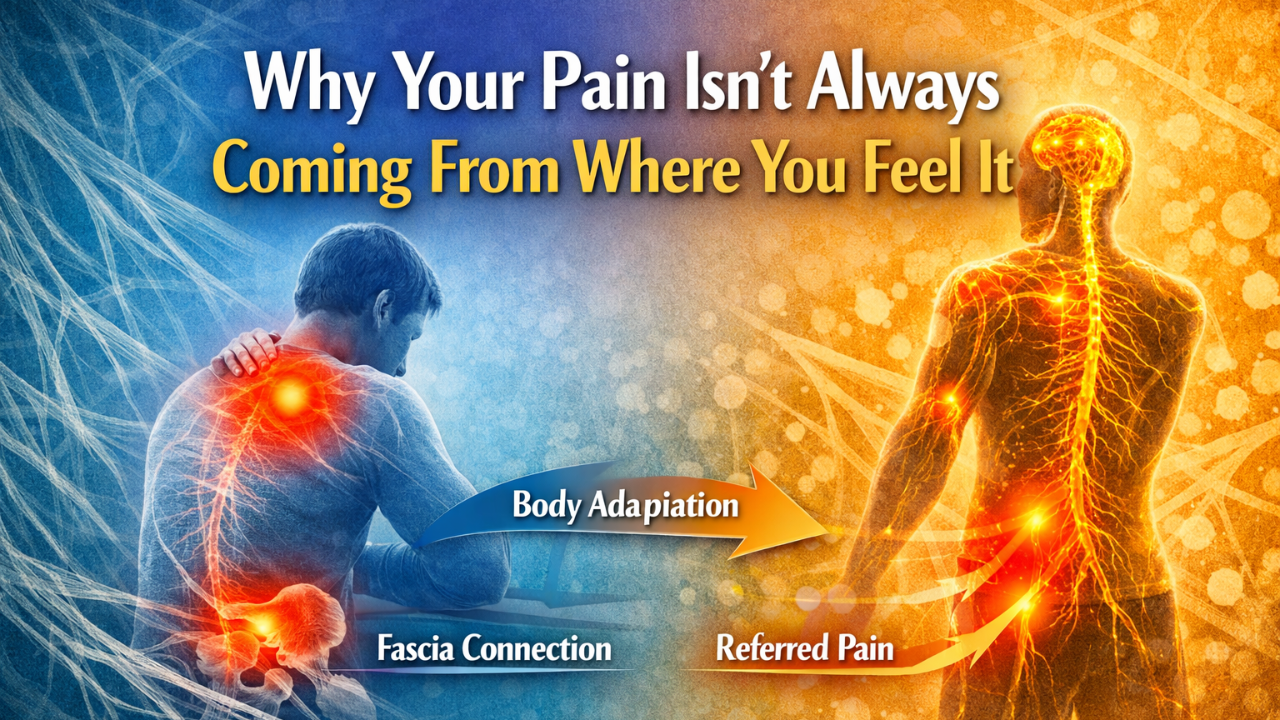
Why Your Pain Isn’t Always Coming From Where You Feel It
One of the most confusing experiences in the body is pain that shows up in one area but originates somewhere else. This is called referred pain, and it’s far more common than most people realize.
Your body is a connected system, not isolated parts. Fascia, nerves, breath mechanics, and movement patterns all influence how and where pain is perceived.
Fascia: The Hidden Pathway of Referred Pain
Fascia is a continuous, three‑dimensional network that wraps every structure in your body. Because it’s interconnected, tension in one area can create discomfort somewhere completely different.
Examples:
-
Hip tightness creating lower‑back pain
-
Rib cage restriction causing shoulder discomfort
-
Foot mechanics influencing knee pain
-
Jaw tension affecting neck mobility
Pain is often a downstream effect, not the source.
Why the Nervous System Redirects Pain Signals
Your nervous system is constantly scanning for threat. When it detects overload, instability, or poor movement efficiency, it may redirect pain to an area with more sensory awareness.
This is why:
-
A weak or unstable area may feel “fine”
-
A compensating area may feel painful
-
The painful area is often the one doing extra work
Your body is not trying to confuse you; it’s trying to protect you.
Compensation Patterns Create Confusing Pain Maps
When one area loses mobility or stability, another area steps in to help.
Common compensation chains:
-
Limited ankle mobility → knee pain
-
Restricted hips → lower‑back pain
-
Tight rib cage → neck tension
-
Poor breathing mechanics → shoulder discomfort
The body is brilliant at adapting, but those adaptations come with a cost.
Hydration and Fascia Glide Influence Pain
Dehydrated fascia becomes sticky, dense, and less able to glide. This increases tension along entire fascial lines, not just one spot.
This is why you may feel:
-
“Pulling” sensations
-
Pain that moves
-
Tightness that shifts throughout the day
-
Discomfort that appears during certain movements
Hydration isn’t just about drinking water; it’s about how water moves through your tissues.
Why Treating Only the Painful Area Doesn’t Work
If you only treat the site of pain, you often miss the root cause.
Pain is a signal, not a diagnosis.
Effective care looks at:
-
Movement patterns
-
Breath mechanics
-
Fascial glide
-
Nervous system regulation
-
Load distribution
-
Daily habits and positions
This is the Baseline approach.
The Baseline Method™ and Referred Pain
At Baseline Health™, we don’t chase symptoms. We restore the system.
RESET Hydration, breath, and nervous system safety.
REALIGN Fascial glide, posture, and movement patterns.
RECOVER Collagen remodeling, metabolic repair, and long‑term resilience.
When the system is supported, pain becomes clearer and often resolves.
Your Pain Has a Story; Your Body Is Communicating
Pain is not random. It’s information.
When you understand the system behind the signal, you stop guessing and start healing.
Baseline Health™
Cell‑First Health. Reset • Realign • Recover™
Lorem ipsum dolor sit amet, consectetur adipiscing elit. Cras sed sapien quam. Sed dapibus est id enim facilisis, at posuere turpis adipiscing. Quisque sit amet dui dui.
Stay connected with news and updates!
Join our mailing list to receive the latest news and updates from our team.
Don't worry, your information will not be shared.
We hate SPAM. We will never sell your information, for any reason.